
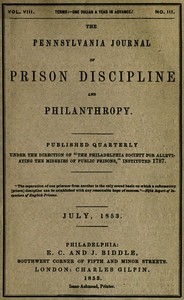
The Pennsylvania Journal of prison discipline and philanthropy (Vol. VIII, No.…
Let's be clear: this is not a novel. The Pennsylvania Journal of Prison Discipline and Philanthropy is a stack of meeting minutes, statistical reports, and philosophical arguments published by a group of 19th-century reformers. They called themselves the Philadelphia Society for Alleviating the Miseries of Public Prisons, which is about the most straightforward mission statement you could ask for.
The Story
The 'plot' is the Society's ongoing fight. Each article is a piece of that battle. You'll read detailed accounts of prison conditions—think overcrowding, disease, and silence rules meant to break the spirit. There are financial reports showing the staggering cost of simply warehousing people. But alongside the grim facts are proposals: arguments for education, for meaningful work, for separating young offenders from hardened criminals. The central tension is between the old idea of prison as a hellish deterrent and the new, radical idea that it could be a place for moral repair.
Why You Should Read It
What got me was the humanity. These aren't dry policy papers. The writers are visibly frustrated and compassionate. They visit the cells, they talk to the inmates, and they are genuinely horrified by what they see. Reading their pleas, you feel the weight of their question: If our system only creates more misery and more crime, what are we even doing? It connects directly to today's debates about rehabilitation vs. punishment in a way that feels startlingly current. It strips away two centuries of political rhetoric and shows the simple, moral problem at the core.
Final Verdict
Perfect for history buffs, true crime fans who want to understand the 'system' part of the story, or anyone interested in social justice. It's not a light read, but it's a powerful one. You won't get a neat narrative, but you will get a profound look at the moment when some people first decided that caging humans wasn't enough—we owed them a chance to become better. If that idea still challenges us today, this journal shows us where the fight began.
Matthew Smith
6 months agoVery helpful, thanks.
Mark Young
1 year agoAs someone who reads a lot, the arguments are well-supported by credible references. A valuable addition to my collection.
Charles Moore
3 months agoA bit long but worth it.
Noah White
4 months agoThis is one of those stories where the emotional weight of the story is balanced perfectly. Definitely a 5-star read.


Lisa White
8 months agoFast paced, good book.