
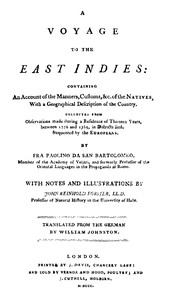
Voyage to the East Indies by a S. Bartholomaeo Paulinus
Forget dry historical accounts. Voyage to the East Indies drops you right into the 18th century alongside Paulinus, a German Carmelite friar with a front-row seat to history. This is his personal travelogue, written as he experienced it.
The Story
There's no traditional plot, but there is a clear journey. We follow Paulinus from Europe, around the Cape of Good Hope, and into the Indian Ocean. He lands in places like Goa, Pondicherry, and travels across southern India. The 'story' is in what he chooses to write down each day. He describes the ships he sails on, the storms they weather, and the first breathtaking sight of a new coastline. Once ashore, he becomes a relentless note-taker. He writes about Hindu religious practices, the layout of cities, the clothes people wear, and the food they eat. He details plants and animals, from spices to tigers, trying to fit them into the European understanding of the natural world. We see his world expand with every page.
Why You Should Read It
What makes this book special is Paulinus himself. He's not a perfect narrator—his views are shaped by his time and religion—but his curiosity often wins out. You can feel his genuine astonishment. One minute he's criticizing a local custom, and the next he's marveling at the engineering of an irrigation system or the beauty of a silk sari. That tension is fascinating. You're not getting a polished, politically correct view. You're getting a real person trying to process the incredible, and sometimes unsettling, differences between his home and this new world. It’s this unfiltered, immediate quality that makes the past feel alive and complicated.
Final Verdict
This is a book for the curious traveler and the armchair historian who wants to go beyond kings and battles. It's perfect for anyone who loves primary sources, travel writing, or just a good, old-fashioned adventure story. If you enjoy seeing history through one person's eyes, with all their biases and brilliant observations intact, you'll be captivated. Just be ready—it’s not a fast-paced novel, but a slow, absorbing walk through a lost moment in time. You'll come away feeling like you've peeked over Paulinus's shoulder as he discovered a continent.
Jennifer Wright
1 year agoI didn't expect much, but it creates a vivid world that you simply do not want to leave. I would gladly recommend this title.
Matthew Young
2 weeks agoAfter finishing this book, the storytelling feels authentic and emotionally grounded. Don't hesitate to start reading.
Anthony King
2 months agoHonestly, it challenges the reader's perspective in an intellectual way. One of the best books I've read this year.





David Walker
2 months agoI didn't expect much, but the narrative structure is incredibly compelling. Exceeded all my expectations.